

Turning 11 Safety Rules in the Manual into a Shop-Floor System
Turning 11 Safety Rules in the Manual into a Shop-Floor System
From a fatal press accident to a UK recall — every rule is written in blood
VFFS Machine Series — for supervisors, safety officers and owners
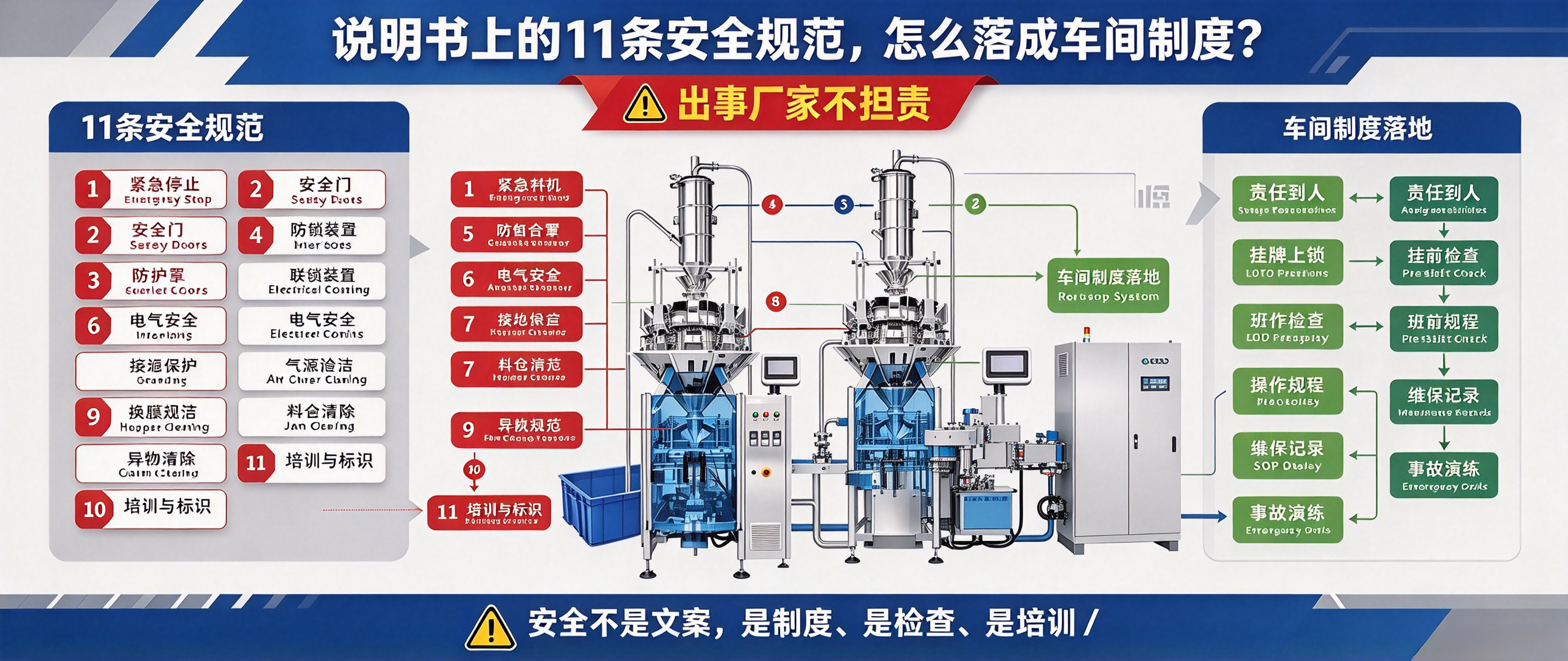

Cover: safety officer checking the E-stop and guard with a checklist — making rules stick
“Never reach your hands or tools into the seal jaws while the machine is running!” Every VFFS manual carries this line — but how many floors take it seriously? In the Taicang 9·17 accident, a worker entering a baler touched the photo-eye, triggered the start, and was crushed to death; direct economic loss was 1.85 million RMB. Most manuals also state in their first safety note: “The company is not responsible for accidents caused by failure to follow these requirements.” This article opens all 11 rules and gives you three tools to make them stick.
01 The Bloody Background: Why These 11 Rules Are Not Optional
• Taicang 9·17: a worker entering the baler touched the photo-eye and was crushed — 1.85M RMB direct loss;
• UK recall: an official product safety report flagged a batch of VFFS machines lacking guards and grounding — serious hazards;
• National standard: in October 2024, the Chinese market regulator issued《Packaging Machinery Safety Requirements》— mandatory safety design;
• Disclaimer: manuals state “not responsible” for rule-breaking — the risk is yours, not the maker's.
⚠ Machines can be repaired; people cannot. The 11 rules are not paperwork — they are a lifeline.
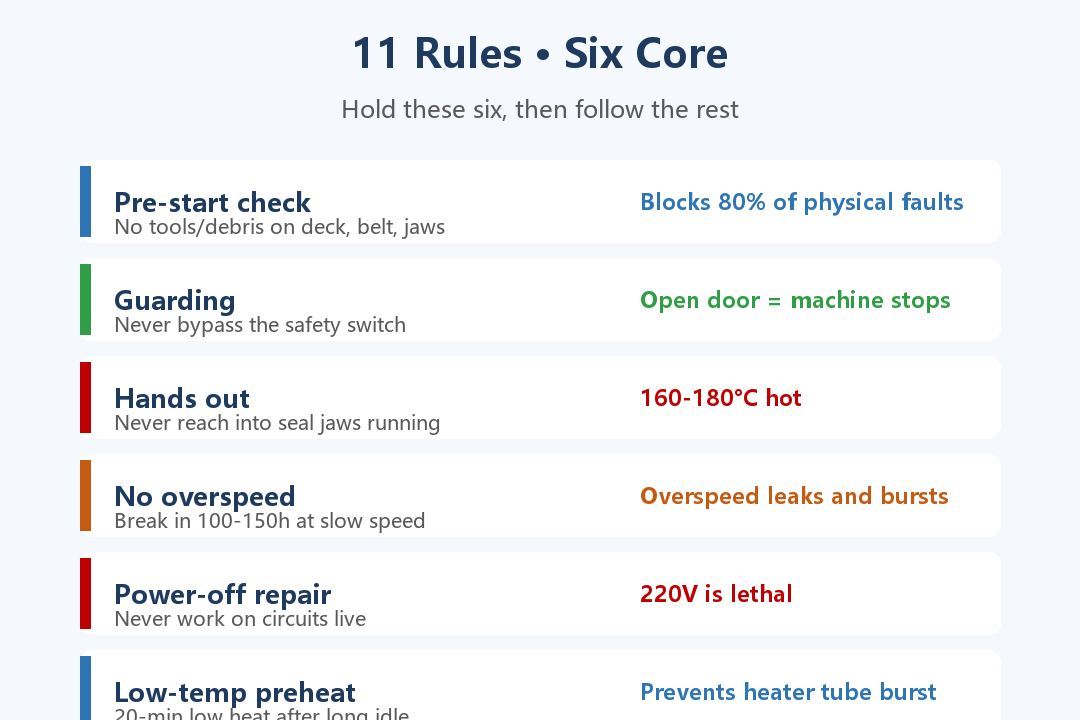

Fig. 1: 11 rules, six core — hold these first (from the safety rules)
02 The 11 Rules, One by One: Which Are Most Violated
• ① Pre-start check: no tools/debris on deck, belt, jaws — a forgotten wrench is the fuse of the next accident;
• ② Guards in position — never tape the safety switch or wire-bypass it;
• ③ Never reach hands/tools into the seal jaws while running — jaws run 160-180°C, burns plus crushing;
• ④ Never put any body part near moving parts — hair, sleeves, gloves can be pulled in;
• ⑤ No frequent button toggling or random parameter changes while running — misoperations cause accidents;
• ⑥ No overspeed, no long high-speed runs — new machines break in 100-150h at slow speed;
• ⑦ No two people operating switches at once — one thinks stopped, another starts: fatal information gap;
• ⑧ Never work on circuits live — 220V is lethal; power off, electricians only;
• ⑨ No drinking, fatigue or untrained operation; ⑩ No unauthorized modification or use outside specified environment;
• ⑪ After long idle or first start: 20-minute low-temperature preheat — prevents heater tube burst.
03 Tool One: Lockout-Tagout
• Who repairs, who tags: before repair, lock and tag the power/air source — “Repair in progress, do not start”;
• Who removes, who starts: only the tag owner removes and starts — kills the “I thought you stopped it” gap;
• Action: write LOTO into the maintenance process; electrical work enforces it strictly.
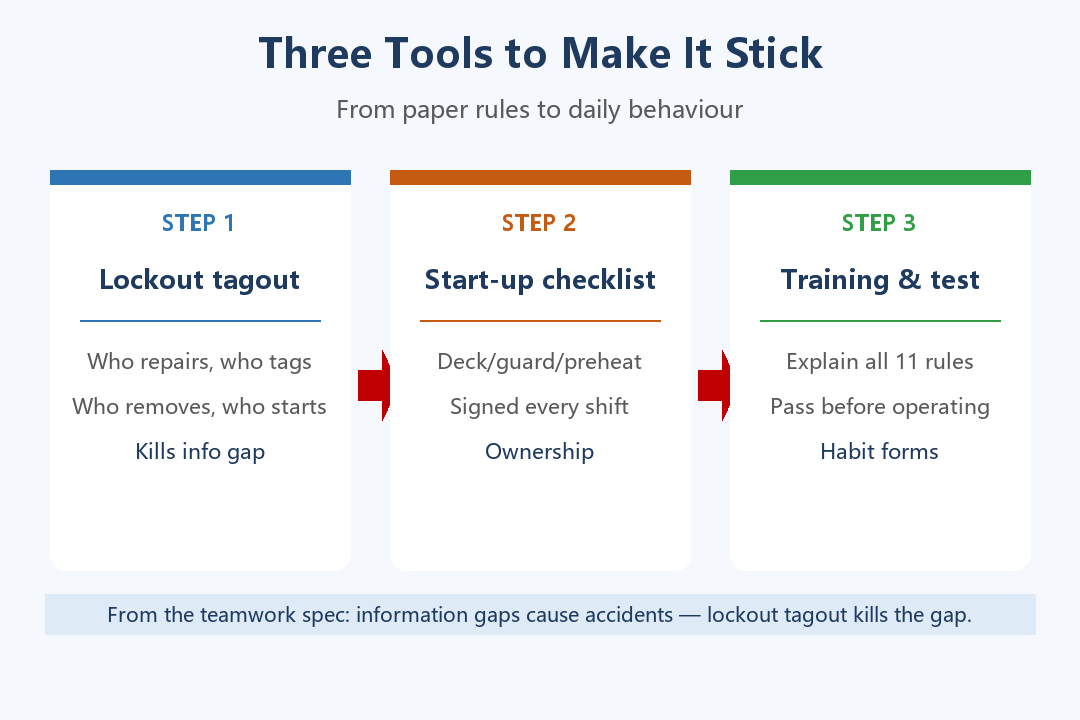

Fig. 2: Three tools to make it stick — lockout tagout, start-up checklist, training & test (from the safety rules and teamwork spec)
04 Tool Two: The Start-Up Checklist
• Signed every shift: deck clear, guard closed, safety switch valid, low-temp preheat — four ticks and a signature;
• Verification: start the machine, then open the guard — if it does not stop immediately, the switch is dead; fix now;
• Action: tape the checklist by the machine; sign and check every shift until it is muscle memory.
05 Tool Three: Training & Assessment Loop
• Induction: explain all 11 rules with real accident cases; new hires pass the safety gate before operating;
• Regular tests: quarterly hands-on safety check; fail = retrain;
• Culture: write “check first, start, then produce” into handover; the safety officer audits and reports weekly.
Table 1. 11 rules mapped to shop-floor system (from the safety rules)
|
Rule Group |
Core Content |
Floor Action |
|
Pre-start |
No tools/debris on deck, belt, jaws |
Sign the start-up checklist |
|
Guarding |
Never bypass the safety switch |
Verify: open door stops machine |
|
Running bans |
No hands in jaws, no body near moving parts |
Training + assessment |
|
Discipline |
No toggling, no overspeed (break-in 100-150h) |
Write into handover SOP |
|
Multi-person |
No double operation, LOTO for repairs |
Lockout-tagout system |
|
Electrical & state |
Power-off repair, no drink/fatigue, no modification, 20-min preheat |
System + training + audits |
Final Thoughts
Rules printed in the manual are the maker's disclaimer; rules built into the shop floor are the company's lifeline. Lockout-tagout kills the information gap, the checklist turns checking into habit, assessment turns habit into culture — run the three tools and the 11 rules are truly in place.
Reply with the keyword “safety” to get the VFFS Start-Up Checklist and Safety Training Assessment Sheets (printable). Need a safety system plan for your floor? Contact the source factory anytime.
Follow the account — more practical content is on the way.


