

Exporting VFFS Machines to Europe & the US: 6 Things to Lock Before Ordering
Exporting VFFS Machines to Europe & the US: 6 Things to Lock Before Ordering
Power, certification, language, logistics, after-sales, acceptance — the 6 clauses your contract needs
VFFS Machine Series · — for importers and export-minded factories
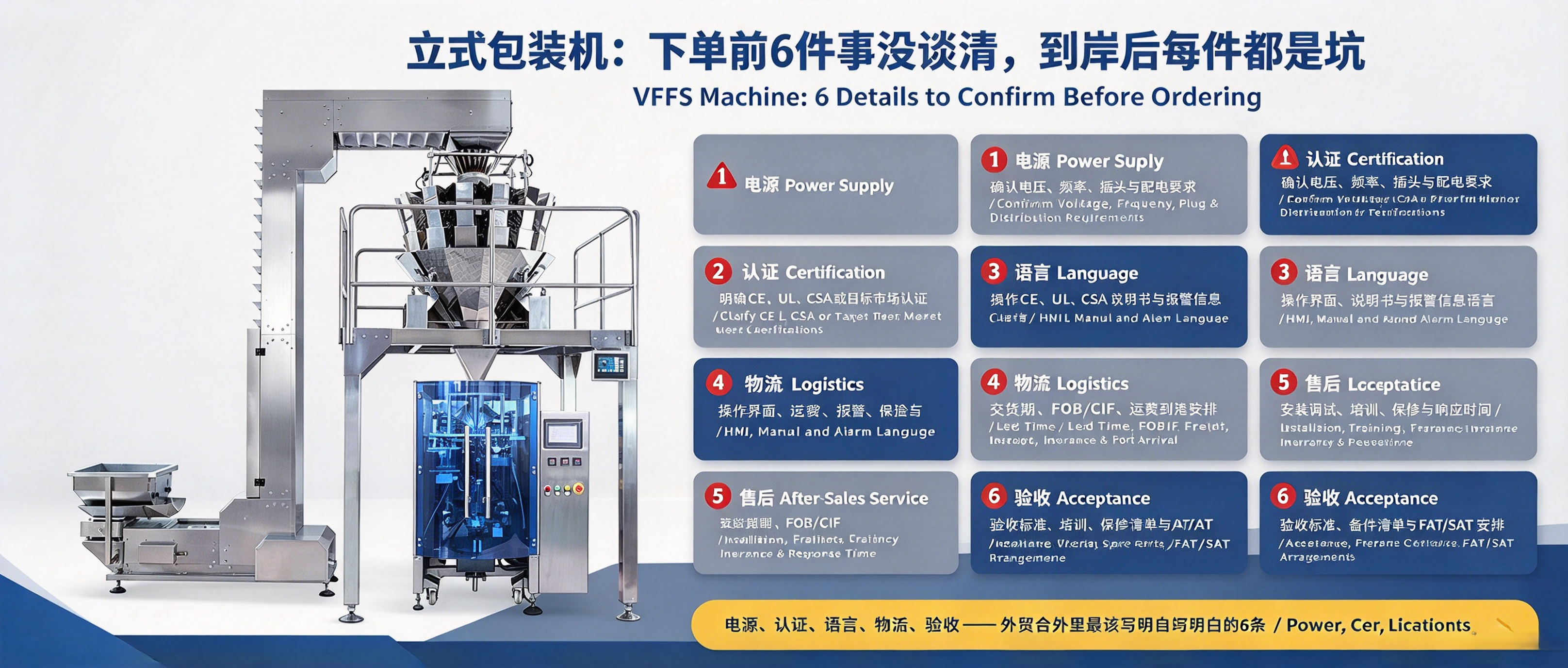

Cover: VFFS crated for export — wooden case, forklift, container
The biggest difference between domestic and export sales of VFFS machines: at home a mistake can be fixed next day on site; overseas, a mistake waits two weeks for the next sailing. This article lists the six things to lock before exporting to Europe or the US — put every one of them in the contract, and arrival is smooth.
01 Power & Air: Confirm the Site Before the Machine
• Voltage/frequency: Europe 230V/50Hz, US 110V or 220V/60Hz — different voltage changes the VFD and temperature controller config;
• Air: a VFFS needs compressed air — confirm pressure and fitting at site (6.5kg is common in China);
• Action: put “voltage / frequency / air supply” into the contract's technical clause so the factory builds an export version.
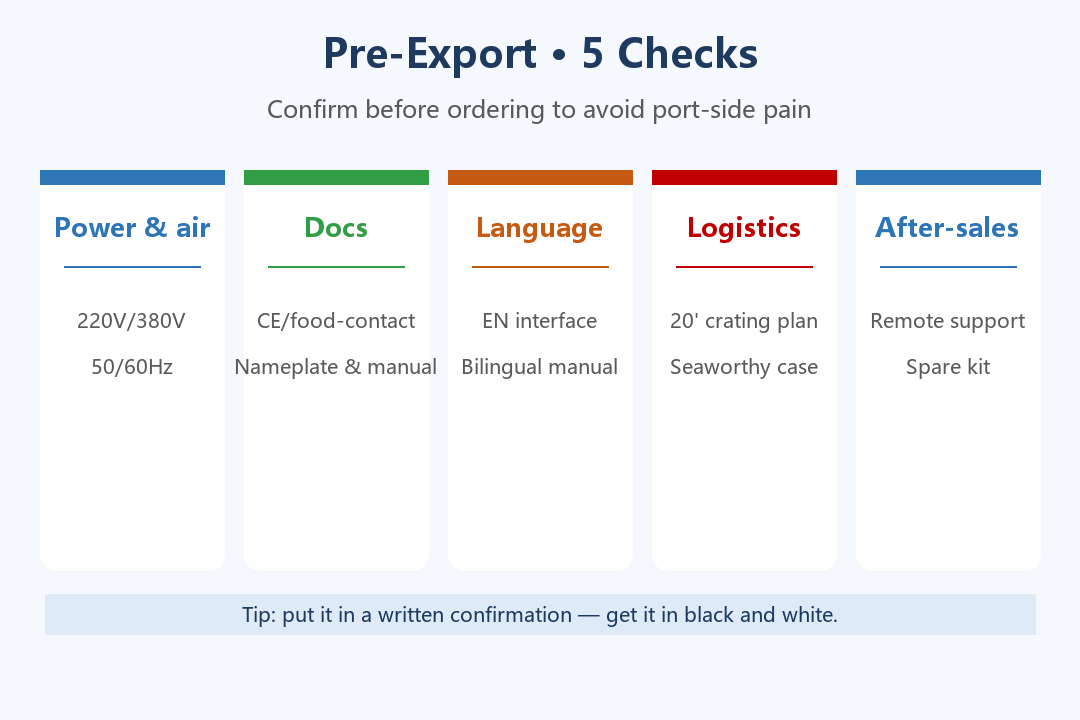

Fig. 1: Five pre-export checks (from the principle doc and operation flow)
02 Certification & Docs: CE Is Not the Whole Story
• Electrical safety: CE (Machinery + EMC) common for the EU; UL/ETL or self-declaration in the US — confirm per destination regulations;
• Food contact: hopper, fill tube and seals touching food need a food-contact declaration (FDA / EU 1935/2004);
• Document pack: nameplate, certificate, CE declaration, wiring diagram, operation manual — one missing document stalls customs or factory audit.
03 Language & Interface: English UI Is Not “a Free Translation”
• Touchscreen: confirm a genuine English interface — a Chinese UI with an overlay translation fails more; the English UI is stable;
• Manual: bilingual manual with clear wiring diagrams so a local electrician can safely connect;
• Screen texts: alarms and parameter names all in English — only then operator training lands.
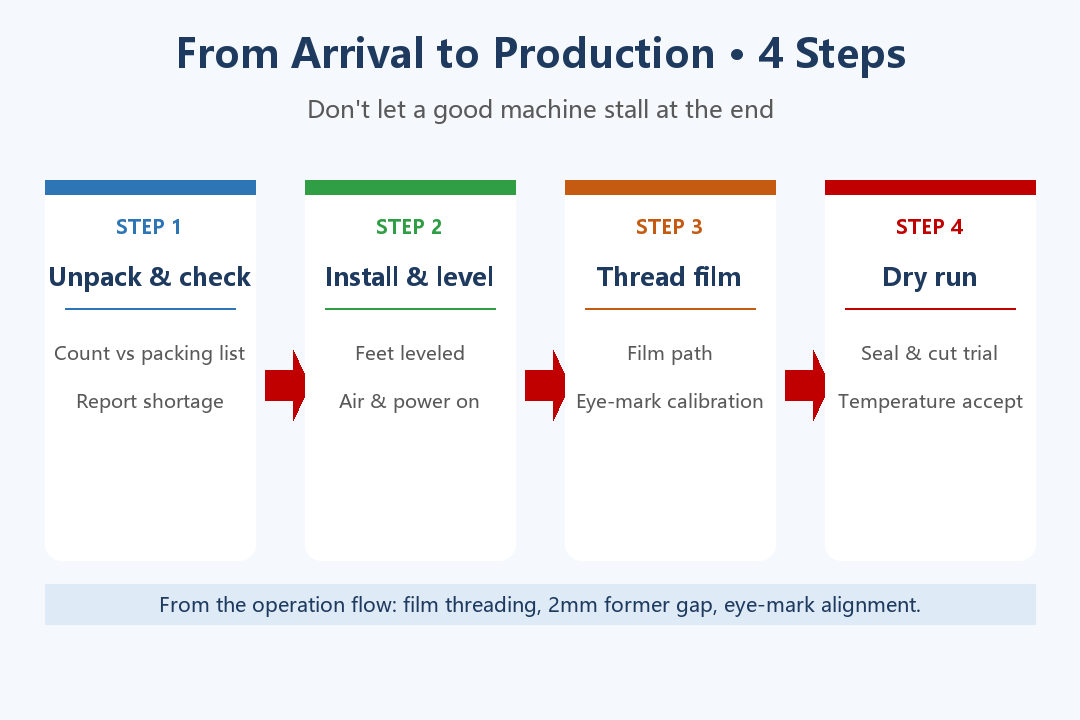

Fig. 2: Four steps from arrival to production (from the operation flow — threading and calibration)
04 Logistics & Packing: A Crate Is Not Just Nailed Wood
• Container: a VFFS usually ships in a 20' container — confirm disassembled dimensions against the door height; a misfit is a rework;
• Packing: export crates are moisture-proof and anti-tipping, fixed to shipping standards; sensors and touchscreen get separate protection;
• Action: check every line of the packing list on arrival — report shortage immediately, before the next sailing.
05 After-Sales & Spares: Write “Remote Support” Explicitly
• Remote support: confirm video/remote commissioning is provided, and the free period;
• Spare kit: heating tubes, temperature controller, seal/cut blades, eye sensor, sensors — one kit ships with the machine, since sea-freight spares take two weeks;
• Action: put the spare list and price table in the contract — avoid “price by mood” after arrival.
Table 1. Six-item export checklist (from the principle doc and operation flow)
|
Item |
Put in the Contract |
Risk at Arrival |
|
Power & air |
Voltage/frequency, air pressure & fitting |
Wrong VFD/temp config, cannot start |
|
Certification |
CE/UL, food-contact declaration, nameplate |
Customs or audit stuck |
|
Language |
English UI + bilingual manual |
Electrician refuses, training fails |
|
Logistics |
Container type, crate standard, packing list |
Does not fit the container or sea damage |
|
After-sales |
Remote support, spare kit & price table |
Two weeks waiting for parts |
|
Acceptance |
Count against packing list, trial-run clause |
Shortage disputes |
Final Thoughts
Importing is about putting uncertainty into the contract. Power and air, certification and documents, language, logistics and packing, after-sales and spares, arrival acceptance — lock all six on paper, and arrival means production, not unboxing a blind box.
Reply with the keyword “export” to get the VFFS Export Checklist. Tell us your destination and voltage — the source factory will propose an export-version configuration.
Follow the account — more practical content is on the way.


