

Intermittent to Continuous: A Four-Stage VFFS Upgrade Roadmap
Intermittent to Continuous: A Four-Stage VFFS Upgrade Roadmap
Prove the process, standardize, add features, then evaluate the switch — climb with capacity
VFFS Machine Series · — for line planners and production managers
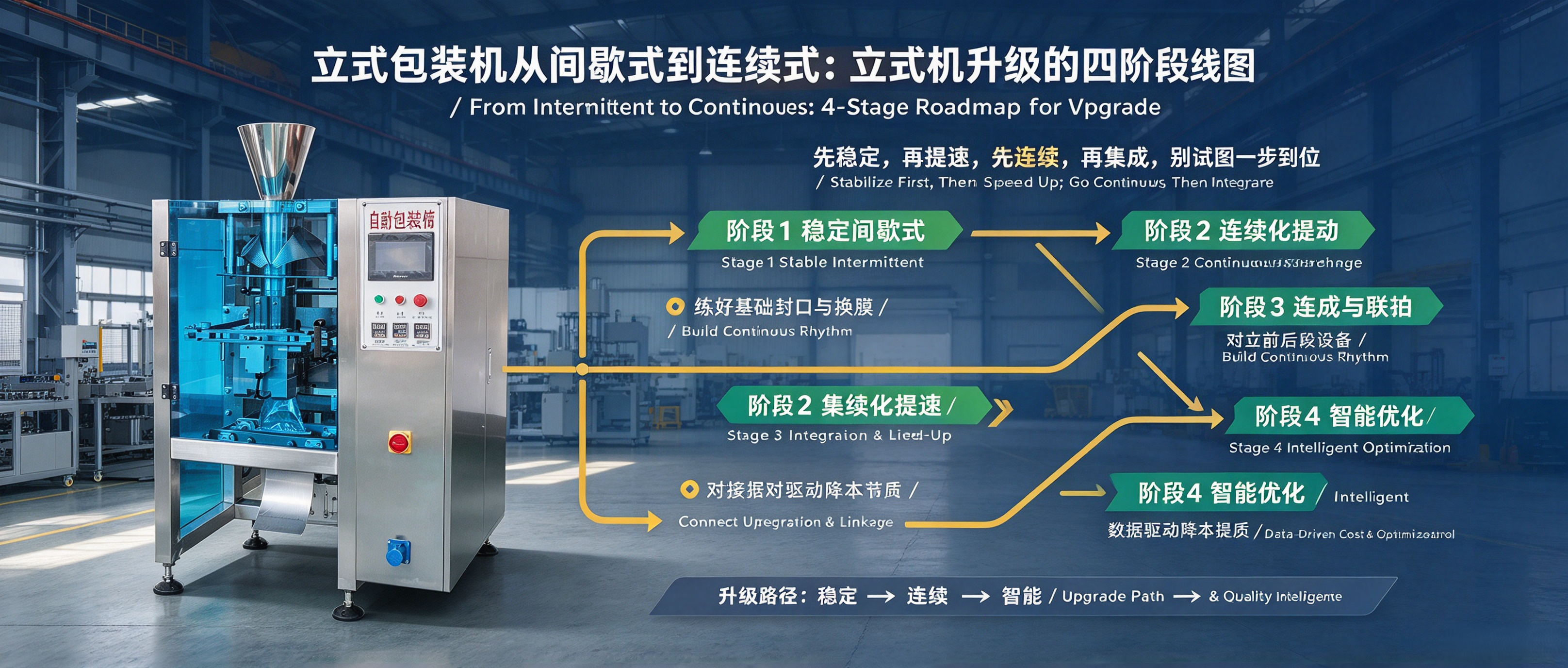

Cover: the whole packing floor — upgrade is changing the system, not the machine
When many companies buy their second VFFS, the first instinct is “go continuous”. But if the process is not proven, the double-price speed is never used. This article lays out a four-stage roadmap: intermittent validation → standardization → add features → continuous evaluation. Climb with capacity and spend on the sharp edge.
01 Stage 1: Intermittent Validation — Prove the Process First
• Goal: prove the process on an intermittent machine — dosing accuracy, seal pass rate, pouch stability;
• Why: intermittent machines are simple and accurate — the lowest-cost way to validate formulas and process;
• Key metrics: weight accuracy per bag, real bags/min, seal pass rate — all passing before expansion.
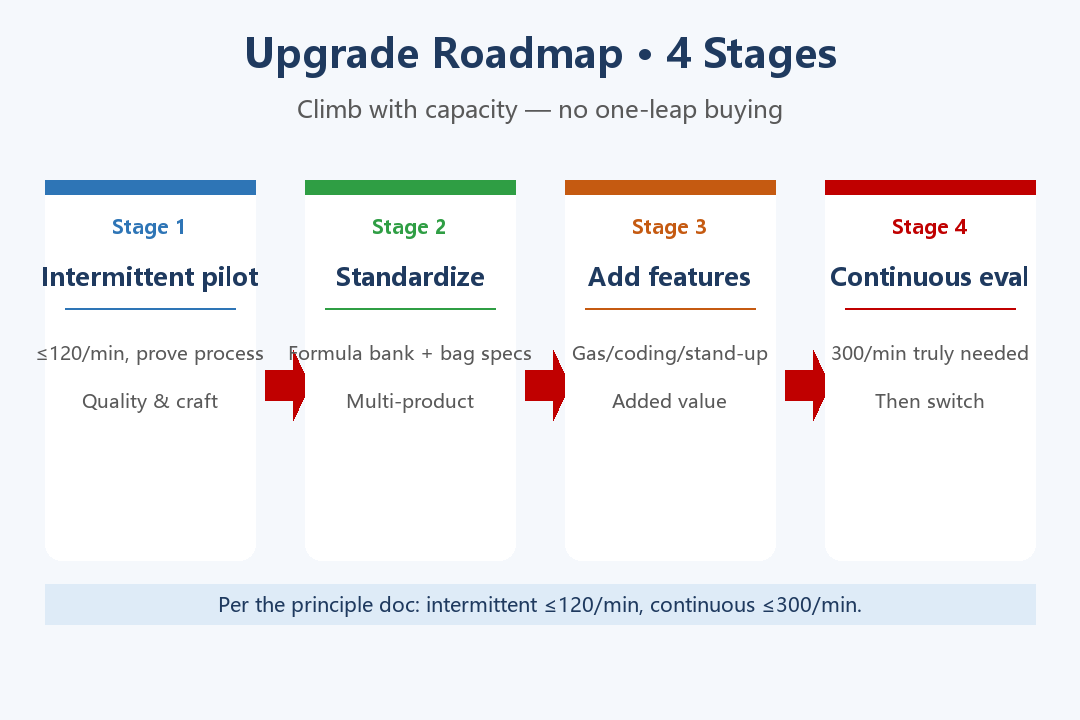

Fig. 1: The four-stage roadmap (from the principle doc, intermittent vs continuous)
02 Stage 2: Standardize — Turn Experience into Parameters
• Goal: build a formula bank — bag length, speed, temperature and timing per product stored on the touchscreen, recalled at one key;
• Why: a master operator's memory is risk — when he leaves, the parameters leave. Formulas let new hands take over;
• Key metrics: changeover time (product A to B), formula count — the target is a 10-minute changeover;
• Evidence: the operation flow's product selection and saved parameters, with tiered touchscreen access (8888/9999).
03 Stage 3: Add Features — Raise Value Per Bag
• Goal: add gas flush, coding, stand-up/gusset devices to the existing machine — value per bag goes up;
• Why: add-ons cost far less than a new machine yet immediately upgrade product tier and price;
• Key metrics: value per bag, new SKUs — one line packing more premium products.
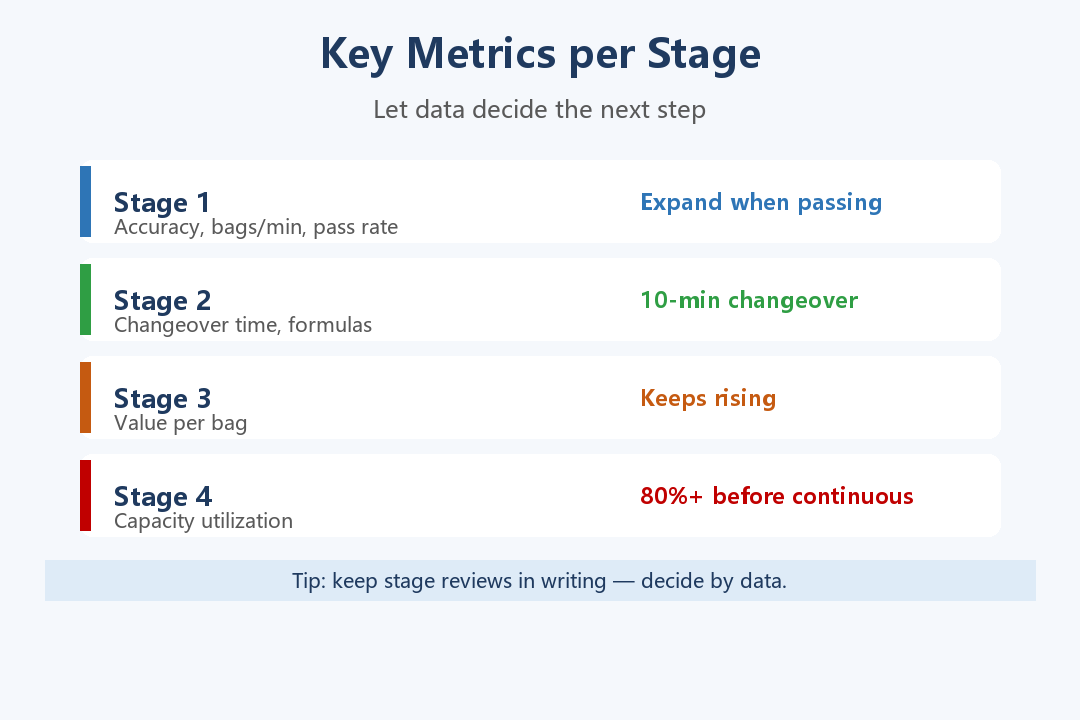

Fig. 2: Key metrics per stage — let data decide the next step (from the principle doc and operation flow)
04 Stage 4: Continuous Evaluation — Switch Only When You Really Need 300/min
• Signal: shift demand consistently exceeds the intermittent ceiling (~120/min), with formulas and process already standardized;
• Pre-check: continuous motion demands more from film, filler and seal/cut sync — confirm seal pass rate stays stable at high speed;
• Key metric: capacity utilization — only above 80% on the intermittent line is a continuous machine worth evaluating;
• Evidence: continuous reaches ~300/min but costs significantly more — do not buy speed you cannot fill.
Table 1. Four-stage roadmap and key metrics (from the principle doc and operation flow)
|
Stage |
Core Action |
Key Metrics |
Basis |
|
1. Intermittent validation |
Prove process: accuracy/pass/pouch |
Grams per bag, bags/min, pass rate |
Intermittent ≤120/min |
|
2. Standardize |
Formula bank, one-key recall |
10-min changeover, formula count |
Operation flow, saved params |
|
3. Add features |
Gas/coding/stand-up |
Value per bag, new SKUs |
By product need |
|
4. Continuous eval |
Evaluate only above 120/min need |
Utilization 80%+ |
Continuous ≤300/min |
Final Thoughts
Upgrade is not changing machines — it is changing systems: prove the process, freeze the parameters, add features, then and only then talk about switching models. Walk the four stages and every ounce of speed you buy gets used, every investment backed by data.
Reply with the keyword “upgrade” to get the VFFS Four-Stage Upgrade Evaluator. Tell us your current model, products and shift output — the source factory will judge whether a continuous machine is worth it.
Follow the account — more practical content is on the way.


