

From Hand Filling to VFFS: Run the Packaging Line Math in 5 Minutes
From Hand Filling to VFFS: Run the Packaging Line Math in 5 Minutes
Wages are only the tip — spread out rework, film waste and turnover to see the real math
VFFS Machine Series ·— for owners and business managers
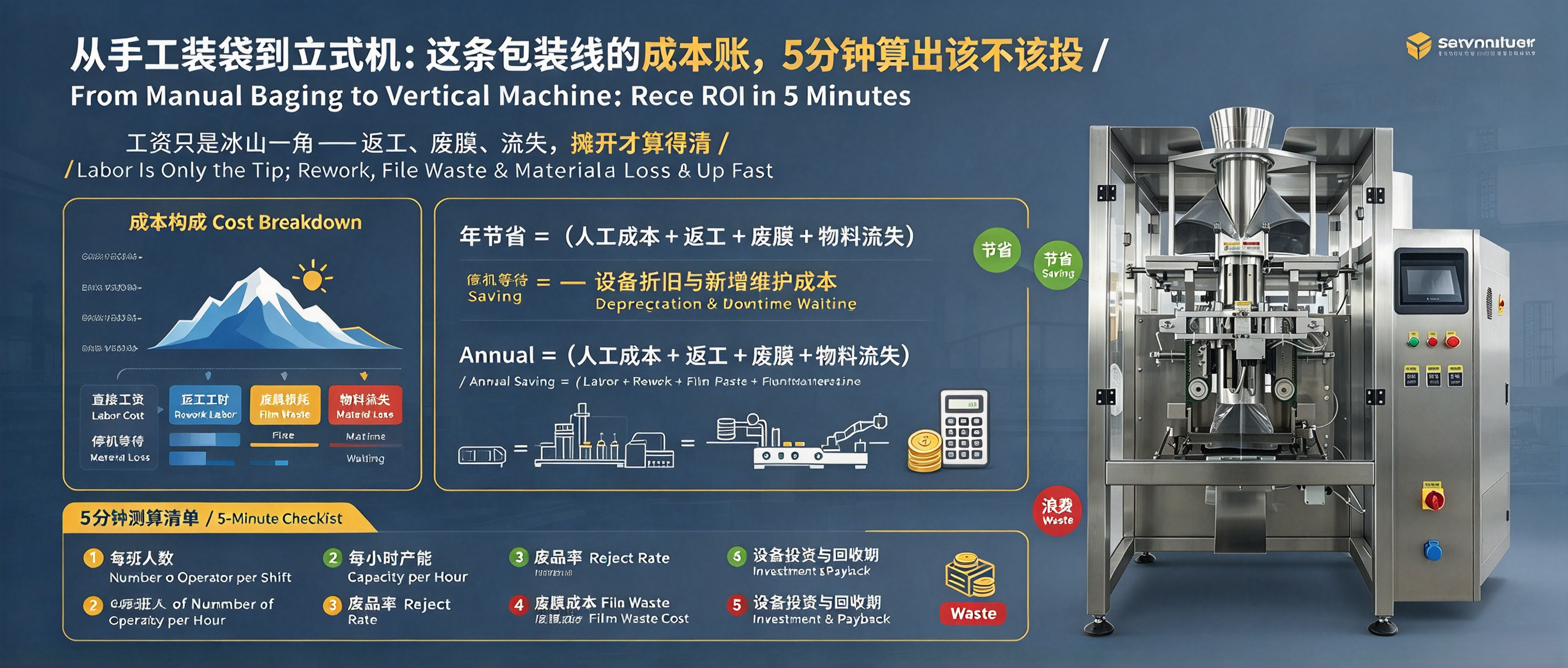

Cover: hand filling vs VFFS — two cost profiles for the same line
Most owners price their packaging by wages alone and miss three hidden costs: rework, film waste and labor turnover. This article spreads the real cost of hand filling out item by item, compares it with the VFFS option — and in five minutes you know whether to invest.
01 The Real Cost of Hand Filling: Wages Are Just the Tip
Hand filling one bag takes: take the bag, open it, weigh (or eyeball), fill, seal, stack. The speed ceiling sets the cost:
• Speed ceiling: a skilled worker fills about 10-15 small bags a minute — under 1,000 an hour, slower near shift change;
• Direct labor: a 3-person packing crew at ~800-1,000 USD/month costs 25,000+ USD a year;
• Key point: wages are the visible tip — the real cost sits below the waterline.
02 Three Hidden Costs: Rework, Film Waste, Turnover
• Rework: wrong specs or missed fills force batch rework — redoing one bag takes time for three;
• Film waste: hand sealing fails more, and failed bags go to scrap with the film — film money vanishes;
• Turnover: packing is tiring and monotonous — new hires are slow, they leave, you retrain; training plus capacity gaps are a quiet big number;
• Opportunity cost: the crew holds your hands — new products and new lines wait while people are stuck packing.
“Add the three up and the true cost of hand filling is typically 1.3-1.8x the wage bill.”
— Industry experience, hidden-cost estimate
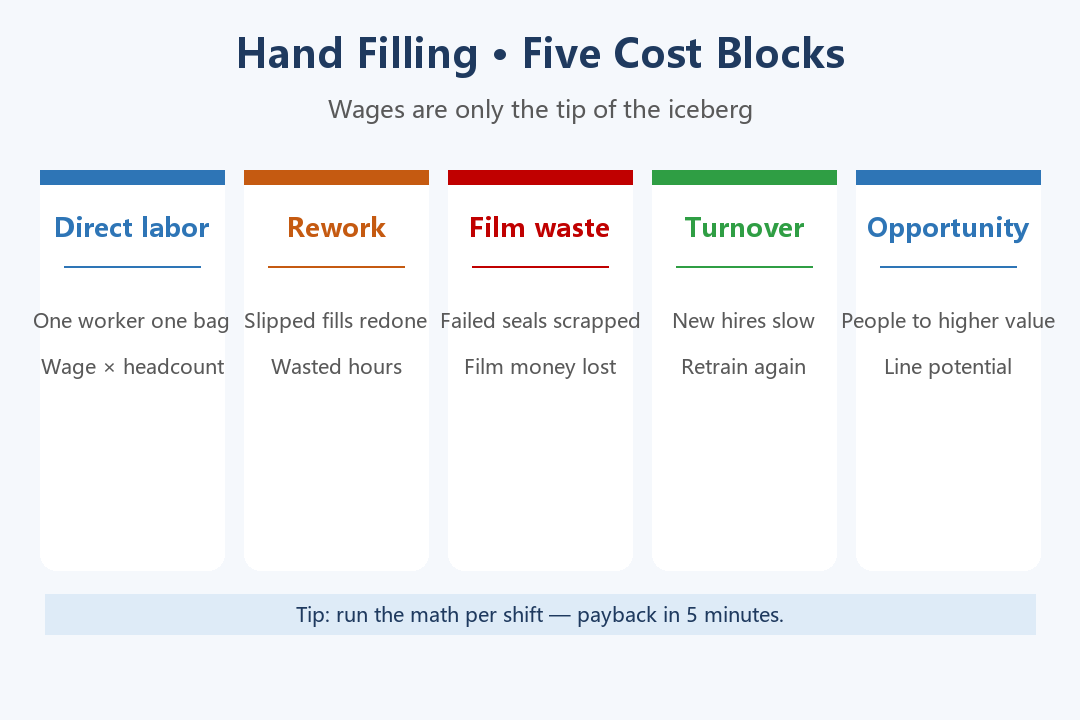

Fig. 1: Hand filling — five cost blocks, wages are the tip (industry experience)
03 The VFFS Ledger: Investment vs Monthly Saving
• Investment: machine price + install + operator training + add-ons (coding/gas as needed);
• Monthly saving: less labor (one operator watches an intermittent machine while others stack), rework gone, film waste down;
• Quality guarantee: metering by multihead/auger — every bag consistent; sealing by temperature-controlled cross seal — quality stops depending on feel.
04 The Math Template: Payback in 5 Minutes
• Step 1 — Investment: machine quote + install = initial cost;
• Step 2 — Monthly saving: for a 3-person crew, 10,000 bags/day, 3,000 USD/month wages — save ~2,500 USD labor plus ~500 USD rework/waste, total ~3,000 USD/month;
• Step 3 — Payback: an intermittent VFFS at 12,000-18,000 USD ÷ 3,000 ≈ 5-7 months.
⚠ Note: typical-order estimates — adjust to your wages, output and scrap rate. The bigger the output, the shorter the payback.
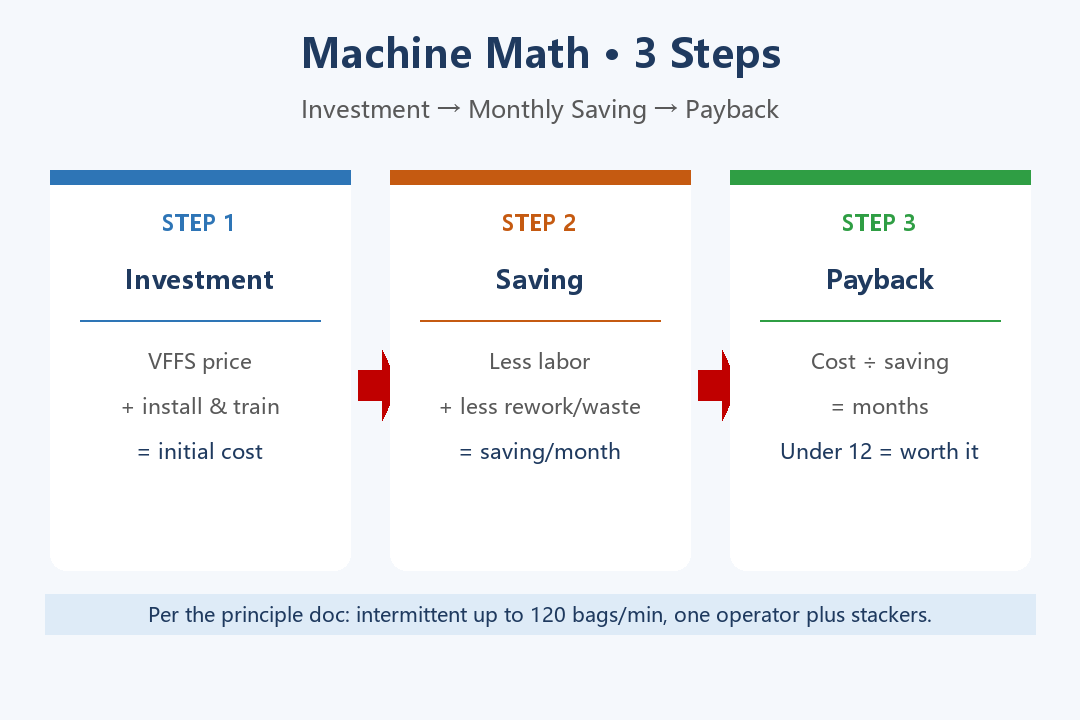

Fig. 2: The 3-step machine math — investment → saving → payback (from the principle doc, machine types)
Table 1. Hand filling vs VFFS total cost (estimate)
|
Cost Item |
Hand Filling (est.) |
VFFS Option (est.) |
Difference |
|
Direct labor |
3-person crew, 25k+ USD/yr |
1 operator + stackers, cut 2/3 |
~2,500 USD/mo saved |
|
Rework |
Wrong specs, batch rework |
Consistent metering, zero rework |
Zero |
|
Film waste |
High hand-seal failure |
Temp cross seal, scrap down |
~500 USD/mo saved |
|
Turnover |
Training + capacity gaps |
Easier job, people stay |
Turnover cost down |
|
Monthly total |
1.3-1.8x the wage bill |
Wages + power + upkeep |
Lower overall |
|
Payback |
— |
Investment ÷ saving, typ. 5-12 mo |
By output |
Final Thoughts
The point of the math is not saving wages — it is counting rework, film waste and turnover too. Most plants see payback within a year. That is not spending money; it is scooping leaked cost back out.
Reply with the keyword “cost” to get the Packaging Line Cost Calculator (Excel template). Send us your daily output, wages and scrap rate — the source factory will run a real estimate.


